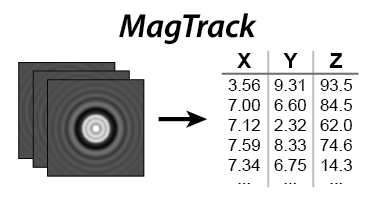
magtrack.simulation#
Simulations for generating realistic synthetic images and Z-LUTs of beads.
Functions#
|
Simulate brightfield images of spherical beads. |
|
Simulate a Z look-up table (Z-LUT) from synthetic bead images. |
Module Contents#
- magtrack.simulation.simulate_beads(xyz_nm, nm_per_px: float = 100.0, size_px: int = 64, radius_nm: float = 1500.0, wavelength_nm: float = 550.0, n_sphere: float = 1.59, n_medium: float = 1.33, absorption_per_nm: float = 0.0, background_level=0.4, contrast_scale=1.0, pad_factor=2.0)[source]#
Simulate brightfield images of spherical beads.
Generates a 3D stack of normalized brightfield images for beads located at the provided coordinates in nanometers. The simulation models refraction and absorption through a spherical object, applies a sampling-limited pupil defined by the imaging wavelength and medium, and returns images cropped to the requested pixel size.
- Parameters:
xyz_nm (array_like, shape (n_beads, 3)) – Nanometer coordinates
[x_nm, y_nm, z_nm]for each bead.nm_per_px (float, optional) – Nanometers per pixel. Defaults to 100.0 nm/px.
size_px (int, optional) – Output image width and height in pixels. Defaults to 64.
radius_nm (float, optional) – Bead radius in nanometers. Defaults to 1500.0 nm.
wavelength_nm (float, optional) – Illumination wavelength in nanometers. Defaults to 550.0 nm.
n_sphere (float, optional) – Refractive index of the bead. Defaults to 1.59.
n_medium (float, optional) – Refractive index of the surrounding medium. Defaults to 1.33.
absorption_per_nm (float, optional) – Absorption coefficient per nanometer. Defaults to 0.0.
background_level (float, optional) – Baseline background intensity scaling. Defaults to 0.4.
contrast_scale (float, optional) – Contrast scaling relative to the background. Defaults to 1.0.
pad_factor (float, optional) – Factor for zero-padding the pupil function to reduce edge effects. Defaults to 2.0.
- Returns:
stack – Normalized simulated bead images with intensities clipped to
[0, 1].- Return type:
ndarray, shape (size_px, size_px, n_beads)
- magtrack.simulation.simulate_zlut(z_nm, nm_per_px: float = 100.0, size_px: int = 64, oversample: int = 1, **simulate_beads_kwargs)[source]#
Simulate a Z look-up table (Z-LUT) from synthetic bead images.
This convenience function renders a stack of bead images at the supplied axial positions using
simulate_beads(), converts each frame into a radial profile viamagtrack.core.radial_profile(), and assembles the results into a Z-LUT where the first row stores the z positions.- Parameters:
z_nm (array_like, shape (n_planes,)) – Z coordinates in nanometers for the reference stack.
nm_per_px (float, optional) – Nanometers per pixel used for the simulation. Defaults to 100.0.
size_px (int, optional) – Width/height in pixels of the simulated frames. Defaults to 64.
oversample (int, optional) – Oversampling factor passed to
magtrack.core.radial_profile(). Defaults to 1.**simulate_beads_kwargs (dict, optional) – Additional keyword arguments forwarded to
simulate_beads()(for exampleradius_nmorwavelength_nm).
- Returns:
zlut – Z look-up table where
zlut[0, :]contains the reference z positions and the remaining rows contain the corresponding radial profiles.- Return type:
ndarray, shape (1 + n_bins, n_planes)