Getting Started#
What is MagTrack?#
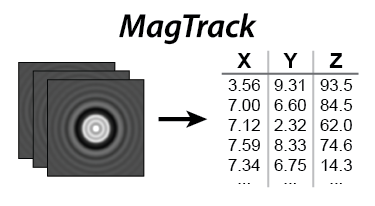
MagTrack is a free open-source Python library for tracking symmetric beads in single-molecule magnetic tweezers experiments.
Sub-pixel XYZ coordinates
GPU accelerated (optional, requires a CUDA-capable GPU)
Python notebook included with examples
Documented, tested, and benchmarked
Runs on Windows, macOS, and Linux
Easy installation with pip
System requirements#
Python >=3.9
Supports Windows, macOS, and Linux
macOS does not support CUDA GPU acceleration
Installation#
Method 1: CPU only (easier)#
This method supports macOS, Windows, or Linux. But MagTrack will only be able to use your CPU. You can always later use method 2 if you want to add GPU acceleration.
pip install magtrack[cpu]
Method 2: CPU + GPU (a little harder)#
This method supports Windows or Linux. This allows MagTrack to use either the CPU or a CUDA-capable GPU.
Confirm that your system has an NVIDIA GPU.
Install the free CUDA Toolkit.
Versions 11, 12, or 13 are supported.
You can check the installed version by running
nvcc -Vin a terminal such as Command Prompt.
Install MagTrack using the pip command that matches your CUDA version:
CUDA Toolkit Version
Pip command
11.x
pip install magtrack[cu11]12.x
pip install magtrack[cu12]13.x
pip install magtrack[cu13]
Verify the installation#
After installing, you can try a function like center-of-mass, which converts an image stack into x,y bead coordinates:
import magtrack
import numpy as np

stack = np.ones((10, 10, 3))
x, y = magtrack.center_of_mass(stack, background="none")

print(f'x: {x}')
print(f'y: {y}')
If working properly, this will output an array of
x: [4.5 4.5 4.5]
y: [4.5 4.5 4.5]
You may receive a warning that GPU-acceleration with CuPy is unavailable if MagTrack was installed with CPU only.